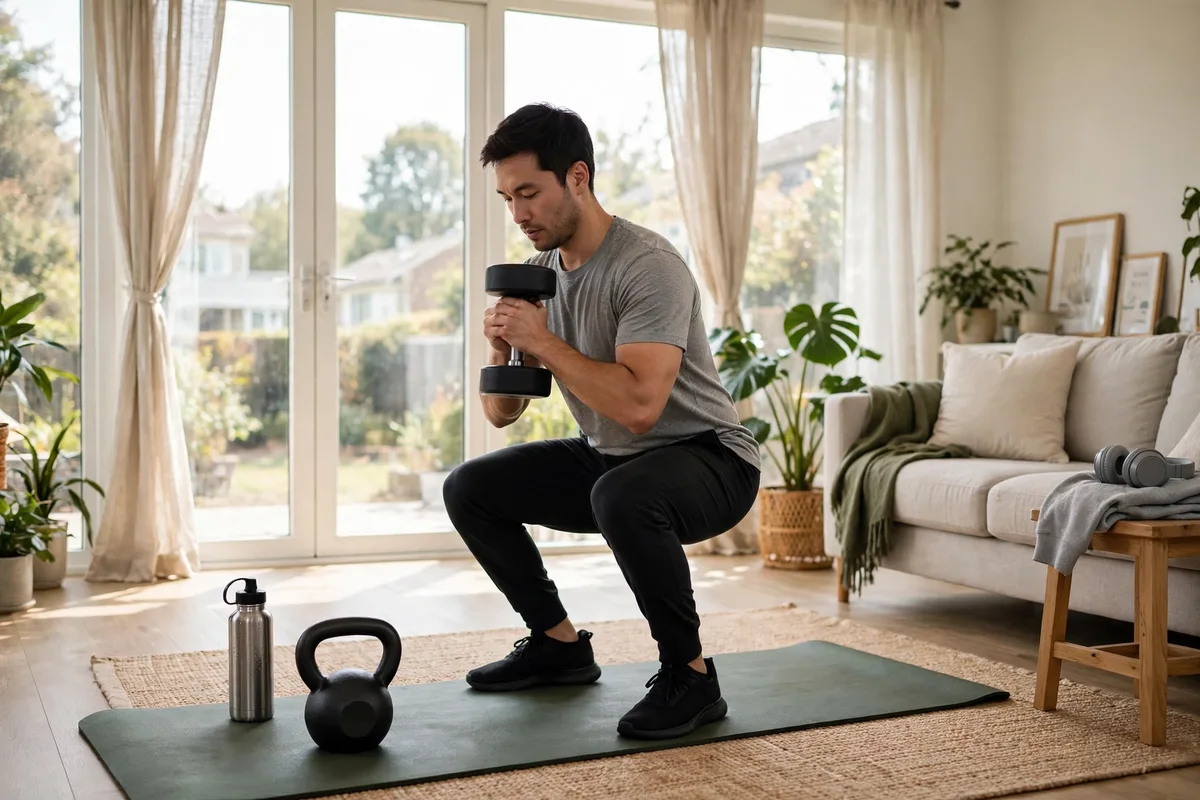
You do not need a gym membership, a rack of machines or an athlete’s background to get stronger. Strength training for beginners is really just a handful of basic movements, practised consistently with good form and gradually increasing challenge — and your living room is a perfectly good place to start. This guide covers the movements that matter, the small amount of kit actually worth owning, a simple first week you can repeat, and how to progress without hurting yourself.
Why strength training is worth a beginner’s time
Muscle is not just about appearance. Regular resistance training supports stronger bones, steadier joints, better balance and posture, and makes everyday tasks — carrying shopping, climbing stairs, lifting kids — noticeably easier. It also pairs well with the cardio you may already do: many beginners combine lifting days with the kind of steady running in our beginner’s running plan, and the two support each other rather than compete.
Perhaps the most beginner-friendly fact of all: new lifters gain strength quickly at first, because much of the early progress is your nervous system learning the movements. Two or three short sessions a week is enough to feel a real difference within a couple of months.
The five movement patterns that cover everything
Almost every exercise you will ever do is a variation of five basic patterns. Learn these and you have a complete toolkit:
- Squat: sitting down and standing up with control. Start with bodyweight squats to a chair, then a goblet squat holding one dumbbell at your chest.
- Hinge: bending at the hips with a flat back, as in a Romanian deadlift with light dumbbells. This builds the back of the body — glutes and hamstrings.
- Push: pressing away from you. Floor press with dumbbells and wall or countertop push-ups are the beginner versions.
- Pull: drawing weight towards you. A dumbbell row, one knee on a chair, covers this without any special equipment.
- Carry: simply walking while holding weights at your sides. It builds grip, core stability and posture all at once.
A session that includes one exercise from each pattern is a balanced full-body workout. That is the whole secret — everything else is refinement.
The only kit you actually need
Start smaller than the internet wants you to. One pair of moderate dumbbells (or an adjustable set if budget allows), a resistance band, and a mat for floor work will carry you through your first months. Add a second, heavier pair of dumbbells when the first pair starts feeling easy on lower-body movements.
Footwear matters more than most beginners expect: you want a flat, stable shoe rather than a soft, cushioned runner for lifting, so your feet can grip the floor. Our guide to choosing the right sport shoes explains what to look for in terms of fit and support. A water bottle and a phone timer complete the setup — that is genuinely it.
Your first week: a simple three-session plan
Train on three non-consecutive days — Monday, Wednesday and Friday, for example — and repeat the same session each time for the first two or three weeks. Repetition is a feature, not a flaw: it is how form improves.
Warm up for five minutes with easy marching on the spot, arm circles and a few unweighted squats. Then work through: goblet squats, 3 sets of 8; dumbbell floor press, 3 sets of 10; one-arm rows, 3 sets of 10 per side; Romanian deadlifts, 3 sets of 8; and a farmer’s carry, 3 walks of about 30 seconds. Rest a minute or two between sets. The last couple of repetitions of each set should feel challenging while your form stays clean — if your form breaks down, the weight is too heavy for now.
Consistency beats intensity at this stage, which is why attaching sessions to an existing anchor helps so much. If you are already building a start to your day, the habit techniques in our guide to building a morning routine that sticks apply just as well to training slots.
How to progress safely
Progress comes from small, steady increases. When you can complete all sets of an exercise with good form and a little energy to spare, either add a repetition or two, or move up to the next weight and drop back to the lower end of the repetition range. Change one thing at a time and write down what you did — a notebook or phone note turns guesswork into a plan.
Rest is part of the programme, not a break from it. Muscles adapt between sessions, so keep at least one easier day between workouts for the same muscle groups, and treat sleep and food as training inputs. What you eat around your training genuinely affects recovery and energy; our guide to improving digestive health covers the everyday habits that keep your system comfortable while your routine ramps up.
Some muscle soreness a day or two after a session is normal for beginners and fades as you adapt. Sharp pain, joint pain or anything that alters how you move is not — stop that exercise, and if it persists, get it checked by a professional before continuing.
Mistakes that slow beginners down
The classic errors are rushing the weight up before the form is ready, copying advanced programmes built for people with coaches and years of practice, and skipping the movements that feel hard — which are usually the ones you need most. Another quiet progress-killer is training only indoors on the same patch of carpet; varying your environment helps motivation, and many local parks have the space and benches for bodyweight work, as our guide to family sports parks and outdoor facilities shows.
Finally, do not measure yourself against anyone else’s numbers. Your only meaningful comparison is with your own notebook from last month.
The bottom line
Strength training for beginners works when it stays simple: five movement patterns, a pair of dumbbells, three short sessions a week, and small increases recorded as you go. Start lighter than you think you should, protect your form on every repetition, and let consistency do the heavy lifting. Within a few months, the person carrying the shopping, climbing the stairs and standing a little straighter will make the case better than any programme description can.